We help you find the right words

Eventos internacionales

traduccion humana vs traduccion IA

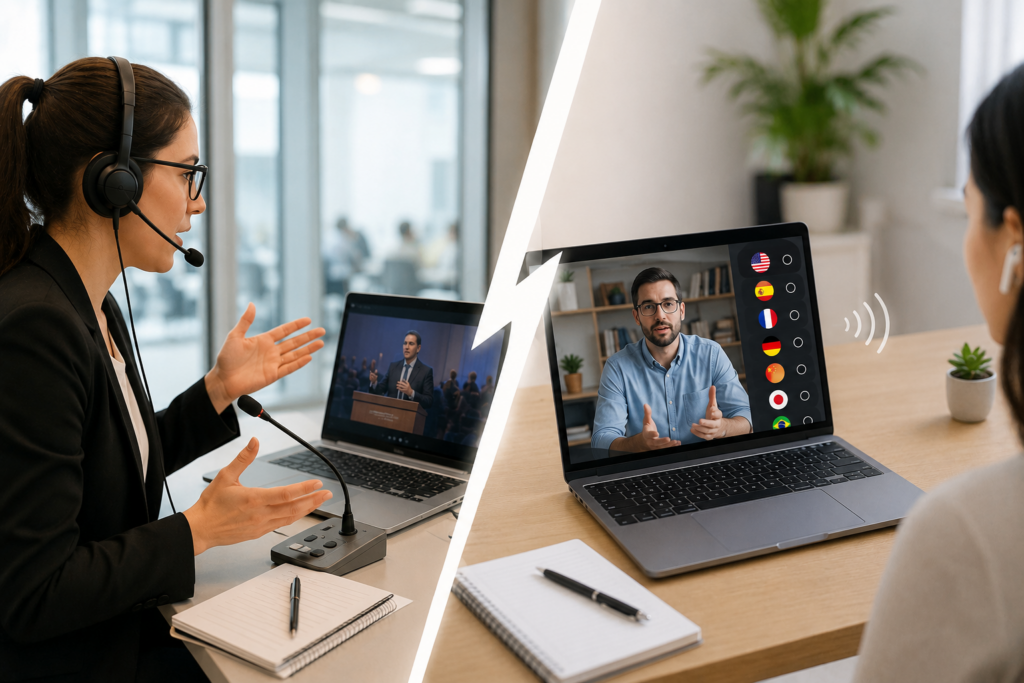
Professional Simultaneous Interpretation vs AI in Events: How to Choose

Professional simultaneous interpretation remains the most widely used solution in conferences, international meetings, and high-level corporate events. At the same time, the rapid development of artificial intelligence has significantly expanded the options available to support multilingual communication in these environments.

This naturally raises a common question in corporate event planning: ¿A o B? A or B? which is the better choice: human interpretation or AI-powered simultaneous interpretation?

There is no single answer. The most suitable option depends on the nature of the event, the level of interaction, the budget available, and the degree of accuracy required.

Impact on the event experience

The choice of interpretation method goes beyond technical accuracy. It directly influences the overall experience of the event. When communication flows naturally, audiences are better able to follow the content, stay engaged, and connect with the message being delivered.

In contrast, when the chosen solution is not fully aligned with the dynamics of the event, issues such as interruptions, loss of nuance, or difficulty following the discourse can emerge, particularly in fast-paced or multilingual settings.

Level of interaction as a key factor

One of the most relevant aspects to consider is how interactive the event actually is.

In structured presentations or keynote-style sessions, automated solutions can often perform adequately, as the speech tends to be more linear and predictable.

However, in environments where there is active participation—such as discussions, Q&A sessions, overlapping conversations, or spontaneous exchanges—interpretation requires a much higher level of adaptability. Real-time shifts in pace, interruptions, and changes in direction all demand a more responsive approach.

Current limitations of AI-based interpretation

AI-powered interpretation tools have evolved significantly in recent years, particularly in terms of speed and language coverage.

However, there are still areas where limitations may appear:

  • Understanding full contextual meaning across extended discourse
  • Managing sudden change of topic or interruptions
  • Capturing nuance, irony, or implied meaning
  • Maintaining consistency in multi-speaker environments

As a result, performance can vary considerably depending on the complexity and dynamics of each event.

Consequences of a mismatch in the solution

Choosing an interpretation system that does not align with the nature of the event can have a noticeable impact—both on comprehension and on the overall perception of the event itself.

In corporate settings, clarity and accuracy are not only technical requirements, but also strategic elements that shape how the organisation and its message are perceived.


When can AI be effective?

AI-based simultaneous interpretation can be suitable when:

  • The content is relatively predictable and straightforward
  • Content is not sensitive
  • Confidentiality is not required
  • Speakers communicate clearly, in a structured and at a slow pace
  • The main goal is to understand the general message
  • The budget is limited
  • A large number of languages need to be supported simultaneously

When does human interpretation work best?

Professional interpretation is preferred and valued when:

  • The content is technical or specialized
  • The expectation for message accuracy is high  
  • There are important commercial or strategic implications
  • Complex discussions take place
  • Multiple speakers interact dynamically
  • Hay participación activa de varios interlocutores
  • Nuance and precision are essential
  • Confidentiality must be ensured

How to approach the decision

In most cases, the decision can be guided by three key questions:

  • Is the event informative or interactive?
  • Is the content general or specialized?
  • Is linguistic accuracy critical to the outcome of the event?

The more the answers lean towards interaction, complexity, and precision, the stronger the case for human interpretation.

Another option: a hybrid approach

The integration of professional simultaneous interpretation with real-time text-based AI support tools is an emerging hybrid solution. This approach converts spoken language into text in real time and displays it in the selected language on screens, mobile devices, or virtual event platforms providing live subtitling for both in-person and online formats.

Conclusion

AI may be suitable for informational or low-complexity events where scalability, linearity, and predictability are the main priorities. However, professional simultaneous interpretation remains the benchmark solution in environments where accuracy, real-time interaction, and high-quality communication are essential.

Furthermore, combining professional interpretation with technological support tools such as speech-to-text or real-time subtitling helps address all key dimensions: Speech-to-text o subtitulado en tiempo real permite completar todas las aristas:

  • Message accuracy
  • Multilingual scalability
  • Content accessibility
  • Attendee experience

The aim of this article is to outline the key criteria for making an informed decision depending on the type of event. In many cases, the choice is not simply A or B, but rather identifying the most effective combination of resources to ensure optimal communication based on the event’s specific needs.

Speech to text

Professional Simultaneous Interpretation vs AI in Events: How to Choose Read More »

Interpretation booths

The Power of Correct Interpreter Team Selection: Essential Competencies

We are constantly told about the astounding ability of simultaneous interpreters to switch from one language to another in microseconds and in real-time. People say it’s admirable.

And indeed, conference interpreters are the true invisible heroes of global communication. Their skill in handling languages, their mental agility, and their ability to grasp cultural nuances are truly worthy of admiration.

However, excelling in this field requires much more than being bilingual or multilingual; interpreters must possess a highly specialized set of skills and competencies, developed over years of training and experience in specific sectors.

Here are the competencies we consider most important:

1. Linguistic and Cultural Mastery

The first pillar of a conference interpreter is their perfect command of the languages they work with. But this goes beyond fluency; it involves a deep understanding of cultural nuances, idiomatic expressions, and subtleties that can completely alter the meaning of a message. Interpreters must be able to quickly adapt to different syntaxes, grammatical structures, and communication styles, understanding and conveying the tone, intention, and context of what is said—fundamental for ensuring accurate and coherent interpretation.

2. Advanced Cognitive Abilities and Unstoppable Curiosity

Simultaneous interpretation, the most common mode in conferences, is where interpreters listen, process, and reproduce the message in another language simultaneously. This requires extraordinary concentration, memory, and mental agility.

Simultaneous interpretation demands a working memory that allows the interpreter to retain fragments of information while processing and translating simultaneously. This memory must handle precise details, such as numbers, proper names, or technical terms, while still capturing the overall meaning of the speech. On the other hand, mental agility is crucial for making quick transitions between languages, adapting phrases to the cultural context, and resolving linguistic or conceptual problems in real time—even anticipating the speaker’s next words—all while maintaining the fluency and coherence of the original message.

Another essential skill is curiosity, the cognitive drive that fuels a desire to learn more about a topic. The more curious the interpreter, the better they will perform in specific sectors, as they will immerse themselves in the subject matter and seek to research and delve into the topics assigned to them. This curiosity not only enhances their specialization in specific sectors but also allows them to stay updated with the latest trends and terminology.

3. Expressive Mastery

Linguistic mastery must be complemented by an exceptional ability for verbal expression—fluency is undoubtedly a talent. Interpreters must be expressive not only with words but also with the intention and tone of their voice. This enables them to accurately convey not just the content, but also the emotion and emphasis of the original speaker. Here, agility is essential, as they must react quickly and faithfully reproduce the message, maintaining the coherence and natural rhythm of the speech.

4. Sector-Specific Expertise: Field Experience

One of the key factors that differentiates a good interpreter from an excellent one is their specialization and experience in specific sectors. As industries become more complex, the need for interpreters with specialized knowledge has become critical. In our agency, we take pride in having interpreters specialized in key areas. For example, in the medical and pharmaceutical sector, knowledge of medical terminology and clinical procedures is essential. In this context, a mistake could have serious consequences, so precision is paramount.

Similarly, in the sports field, we segment our interpreters based on their sports subsector specialization, according to their specialization in anti-doping and pharma, the required sports equipment, competition demands, etc. 

5. Technological Skills

Our interpreters are trained not only to handle simultaneous interpretation consoles at in-person events but also to operate multilingual software and platforms for virtual events, enabling remote interpretation. The ability to adapt to new technologies ensures that interpretation is smooth and seamless, whether at an in-person or virtual event.

6. Interpersonal Skills and Absolute Confidentiality

In addition to technical skills, interpreters must be excellent communicators, empathetic, diplomatic and service-oriented. Moreover, they must adhere strictly to confidentiality. Sensitive information discussed in meetings, as well as materials shared for preparation, must be treated with the utmost secrecy. Our agency ensures that all interpreters sign rigorous confidentiality agreements, thus protecting our clients’ information. This, coupled with the use of equipment that guarantees the privacy of information, ensures that no critical information leaks outside of meetings or events.

7. Continuous Improvement

Improvement is a process, it never comes to an end, therefore, it is best that, driven by curiosity and passion for the practice, interpreters constantly seek to improve, be it by documenting themselves, taking on new challenges, training, deepening their knowledge of a sector, in short, actively expanding their practice. Our interpreters are constantly on interpreting assignments, honing their skills and expanding their knowledge.

Finally

This collection of personal, interpersonal, linguistic, and other competencies comes from more than 15 years of evaluating interpreters and linguists across various disciplines, forming the basis for selecting our team. Our conference interpreters bring these skills together with their unique individuality and special contributions. The driving force behind it all is our passion for what we do.

Other articles

The Power of Correct Interpreter Team Selection: Essential Competencies Read More »

WhatsApp Messenger