We help you find the right words

Roser Quiroz

Healthcare webinar Spanish in USA

Simultaneous Interpretation for Healthcare Webinars: How to Reach Spanish-Speaking Audiences in the U.S.

Por ¡Habla! Translation & Interpretation · Remote simultaneous interpretation for U.S. healthcare organizers


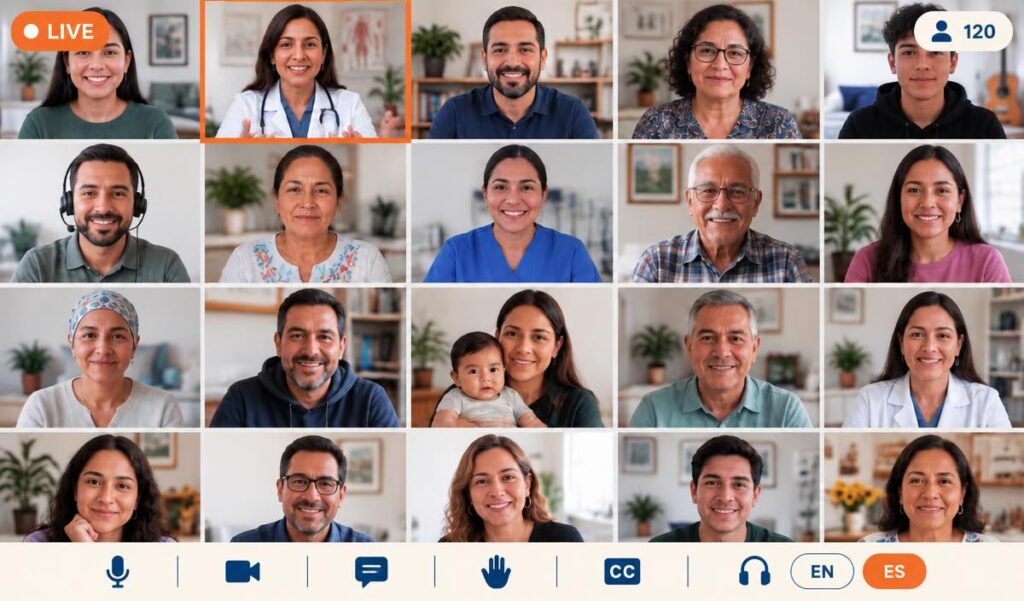
Your webinar on diabetes prevention is ready. The speakers are confirmed, the slides are polished, and your registration list includes hundreds of Spanish-speaking patients, community health workers and clinicians. Then someone asks the question that gets skipped more often than it should: how will they actually follow along?

This guide is for the people who organize healthcare webinars, trainings and online conferences in the United States. It explains how remote simultaneous interpretation (RSI) works, what separates a smooth interpreted event from a frustrating one, and the details most guides leave out.

Why Spanish-speaking audiences deserve more than a translated slide deck

Spanish is by far the most common language among U.S. residents with limited English proficiency (LEP): roughly 16 million people as of 2019, according to figures compiled from Census data. A translated PDF helps, but it does not let someone follow a live presentation, ask a question or take part in a discussion.

It also helps to remember that “Spanish-speaking” is not one audience. People of Mexican origin make up the majority of the U.S. Hispanic population (about 57% in 2024, per Pew Research Center). Yet in the New York metro area, Dominicans and Puerto Ricans are the largest groups, and in the Washington, D.C. area roughly a third of Latinos are of Salvadoran origin. Vocabulary, accents and expectations differ, and your interpreters should be chosen with that in mind.

What simultaneous interpretation means in a webinar

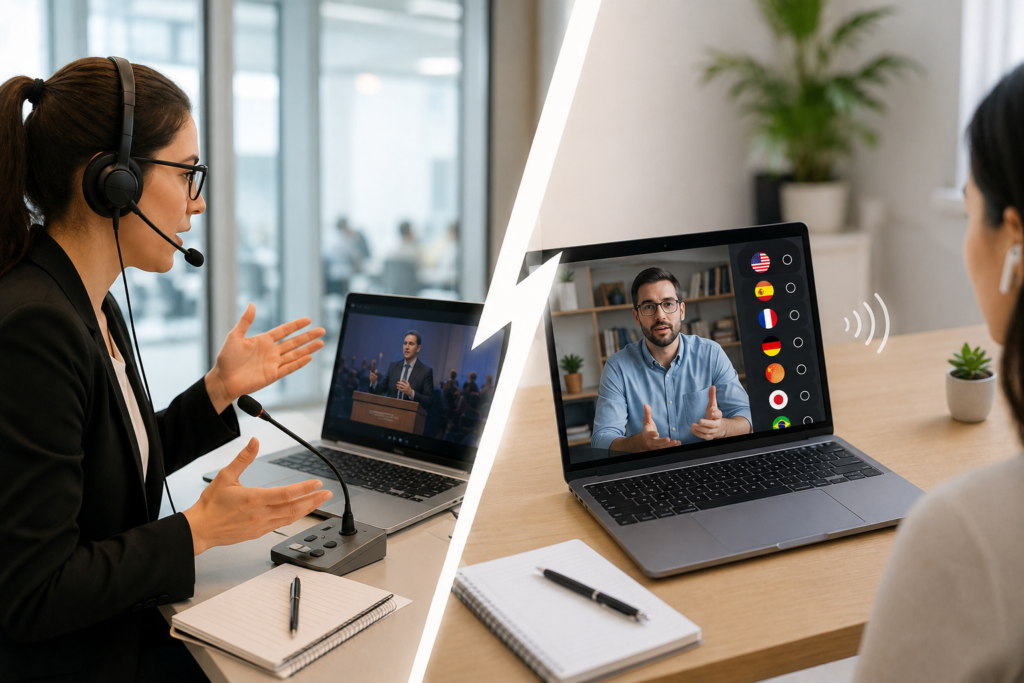
In simultaneous interpretation, interpreters listen to the speaker and render the message into another language with only a few seconds of delay. Attendees choose a language channel and hear the interpreter instead of, or alongside, the original audio.

Two setups are common:

  • • Language channels inside your video platform. Zoom, for example, lets hosts assign interpreters to channels, and Spanish and Portuguese are among its default languages. Attendees open the interpretation menu, pick a language and can mute the original audio. A few practical limits matter: the feature requires a paid plan, it cannot be used with a Personal Meeting ID, and participants and interpreters must join with computer audio.
  • • A dedicated RSI platform. These add features such as smoother handovers between interpreters, private channels for the interpreting team and attendee apps. They are worth considering for larger or higher-stakes events.

En cualquier caso, la plataforma solo entrega el audio. La calidad de la experiencia depende de los intérpretes y de qué tan bien preparados estén.

Why a bilingual colleague is not enough

Being fluent in two languages is not the same as being able to interpret. Simultaneous interpreting is among the most mentally demanding tasks in professional communication, which is why the standard is a team of two interpreters per language who take turns.

Automated translation tools raise a similar concern when they are used on their own. Healthcare content has little tolerance for error: a wrong number in a dosage instruction or a misrendered warning is not a small mistake. For the main audio channel, human interpreters are the safer choice, and whatever you decide, test it with your own content before the event.

There is also a compliance angle for many healthcare organizers. Under the 2024 final rule implementing Section 1557 of the Affordable Care Act, covered health programs must use qualified interpreters when offering language assistance to people with limited English proficiency, and HHS guidance is explicit that someone simply saying they speak the language does not make them qualified. Covered entities are also expected to have documented language access procedures.

Whether a specific webinar falls under these rules depends on the organization and the type of event, and enforcement priorities can change. Confirm with your compliance team or counsel. Even where the rule does not apply, it is a useful benchmark for what “qualified” should mean.

The details that make or break an interpreted health webinar

Most articles stop at “hire a professional.” These are the points that decide whether the event actually works.

1. Decide how Spanish speakers will ask questions

This is the most common gap. If Spanish-speaking attendees can only listen, you have given them access to the content but not to the conversation. Plan the Q&A in advance: interpreters can voice spoken questions into English, or a moderator can read Spanish chat questions aloud. Tell attendees at the start exactly how to participate.

2. Send materials early, with a glossary

Interpreters cannot prepare for what they have not seen. Send the agenda, slides, speaker bios and any scripts well before the event, ideally at least a week ahead, and flag the terms that matter: drug names, procedures, acronyms and the names of programs or clinics. A shared glossary agreed with your interpreters prevents the same concept from being rendered three different ways. It also pays off across a series, because each event builds on the last.

3. Choose the Spanish your audience actually speaks

Patient education and clinical training call for different registers. A talk for patients needs plain language and a respectful, consistent form of address. A session for clinicians may keep technical terms and borrow English ones. Regional vocabulary also varies: the same condition or medication can be called different things depending on where your audience comes from. Tell your interpreters who is listening and where they are from.

4. Design the presentation for interpretation

Speakers who race through dense slides force interpreters to compress or drop information. A few simple habits help: speak at a measured pace, avoid reading slides aloud at speed, spell out acronyms the first time, and be careful with idioms and humor that do not travel. Brief your speakers before the event. This is the cheapest quality improvement available.

5. Protect privacy

If the session includes patient stories or case discussions, remove identifying details. If protected health information could be shared, talk to your compliance team about whether the interpreters should sign confidentiality or business associate agreements, and decide in advance whether the recording will include the interpreted audio.

6. Rehearse the technology with the interpreters

Run a short technical check before the event with the host, the main speakers and the interpreters. Confirm that channels are assigned, audio is clear and the interpreters have a backup way to reach the producer if something fails. Most day-of problems come from skipped rehearsals.

7. Plan the recording

A recording with only the English audio defeats the purpose for Spanish-speaking audiences who watch later. Decide whether you will record the interpreted channel or publish a separate Spanish version.

A note on Portuguese-speaking audiences

If your audience includes Portuguese speakers, plan for it separately. Portuguese ranks third among LEP languages in the Northeast, with several hundred thousand speakers in that region. In Massachusetts it is the second most common LEP language after Spanish. Brazilian immigrants are concentrated in Florida, Massachusetts and California, with New Jersey and New York close behind, and the largest communities are around Boston, New York and Miami.

Two practical points. First, specify Brazilian or European Portuguese, because audiences differ. Second, check actual demand: Brazilian immigrants are, on average, less likely to have limited English proficiency than the overall foreign-born population. A language question on your registration form will tell you whether a Portuguese channel is worth adding.

Beyond the clinic: sports medicine and clean-sport education

One place where interpreted webinars are already routine is anti-doping education. Organizations such as the International Testing Agency, WADA and international sports federations run recurring English-language webinars with simultaneous interpretation into Spanish and other languages. Topics include checking medications, therapeutic use exemptions and the risks of supplements. That is clinical vocabulary where a misunderstanding has real consequences for an athlete.

These examples come mostly from international bodies rather than U.S. organizations, but the lessons carry over to team physicians, pharmacists, athletic trainers and university athletic departments serving Spanish-speaking athletes and support staff. Recurring series reward consistency: when the same interpreters work every session, the glossary improves and so does the quality.

A simple planning timeline

When What to do
4 weeks before Define audiences and languages, choose the platform, book an interpreting agency (or independent interpreters)
2 weeks before Brief the interpreters, share the draft agenda and start the glossary
1 week before Send final slides and scripts, confirm the Q&A plan, brief the speakers
1 to 2 days before Technical rehearsal with the host, speakers and interpreters
Event day Open the room early and test every channel so that all audio, original and interpreted, is heard clearly; announce how to select a language channel
After the event Share the recording with interpreted audio and update the glossary

Questions to ask any interpreting provider

  1. Do you provide two interpreters per language for events longer than about an hour?
  2. Do your interpreters have experience in this health topic?
  3. How do you handle questions from Spanish-speaking attendees?
  4. How do you protect confidential information?
  5. What is included in your quote: preparation time, rehearsal, recording and backup interpreters?

How does ¡Habla! Translation & Interpretation help?

¡Habla! Translation & Interpretation provides remote simultaneous interpretation for webinars, trainings and online conferences from Lima, Peru. We work in Spanish and English and also offer Portuguese, French, Russian and Mandarin Chinese, among other languages. Peru shares U.S. Eastern Standard Time all year (one hour behind Eastern Daylight Time), so our team is aligned with East Coast business hours.

If you are planning a healthcare webinar or training for Spanish-speaking audiences, we are glad to talk through your event and share what we have learned along the way.
 

Simultaneous Interpretation for Healthcare Webinars: How to Reach Spanish-Speaking Audiences in the U.S. Read More »

traduccion humana vs traduccion IA

Professional Simultaneous Interpretation vs AI in Events: How to Choose

Professional simultaneous interpretation remains the most widely used solution in conferences, international meetings, and high-level corporate events. At the same time, the rapid development of artificial intelligence has significantly expanded the options available to support multilingual communication in these environments.

This naturally raises a common question in corporate event planning: ¿A o B? A or B? which is the better choice: human interpretation or AI-powered simultaneous interpretation?

There is no single answer. The most suitable option depends on the nature of the event, the level of interaction, the budget available, and the degree of accuracy required.


Impact on the event experience

The choice of interpretation method goes beyond technical accuracy. It directly influences the overall experience of the event. When communication flows naturally, audiences are better able to follow the content, stay engaged, and connect with the message being delivered.

In contrast, when the chosen solution is not fully aligned with the dynamics of the event, issues such as interruptions, loss of nuance, or difficulty following the discourse can emerge, particularly in fast-paced or multilingual settings.

Level of interaction as a key factor

One of the most relevant aspects to consider is how interactive the event actually is.

In structured presentations or keynote-style sessions, automated solutions can often perform adequately, as the speech tends to be more linear and predictable.

However, in environments where there is active participation—such as discussions, Q&A sessions, overlapping conversations, or spontaneous exchanges—interpretation requires a much higher level of adaptability. Real-time shifts in pace, interruptions, and changes in direction all demand a more responsive approach.

Current limitations of AI-based interpretation

AI-powered interpretation tools have evolved significantly in recent years, particularly in terms of speed and language coverage.

However, there are still areas where limitations may appear:

  • Understanding full contextual meaning across extended discourse
  • Managing sudden change of topic or interruptions
  • Capturing nuance, irony, or implied meaning
  • Maintaining consistency in multi-speaker environments

As a result, performance can vary considerably depending on the complexity and dynamics of each event.

Consequences of a mismatch in the solution

Choosing an interpretation system that does not align with the nature of the event can have a noticeable impact—both on comprehension and on the overall perception of the event itself.

In corporate settings, clarity and accuracy are not only technical requirements, but also strategic elements that shape how the organisation and its message are perceived.


When can AI be effective?

AI-based simultaneous interpretation can be suitable when:

  • The content is relatively predictable and straightforward
  • Content is not sensitive
  • Confidentiality is not required
  • Speakers communicate clearly, in a structured and at a slow pace
  • The main goal is to understand the general message
  • The budget is limited
  • A large number of languages need to be supported simultaneously

When does human interpretation work best?

Professional interpretation is preferred and valued when:

  • The content is technical or specialized
  • The expectation for message accuracy is high  
  • There are important commercial or strategic implications
  • Complex discussions take place
  • Multiple speakers interact dynamically
  • Hay participación activa de varios interlocutores
  • Nuance and precision are essential
  • Confidentiality must be ensured

How to approach the decision

In most cases, the decision can be guided by three key questions:

  • Is the event informative or interactive?
  • Is the content general or specialized?
  • Is linguistic accuracy critical to the outcome of the event?

The more the answers lean towards interaction, complexity, and precision, the stronger the case for human interpretation.

Another option: a hybrid approach

La integración de la interpretación simultánea profesional con herramientas de apoyo tecnológico de texto en tiempo real con IA cierra el círculo para los asistentes. Con esta tecnología convertimos el discurso oral en texto al idioma elegido del usuario y lo mostramos traducido en los móviles celulares o pantallas del evento presencial o virtual, un subtitulado en tiempo real.

Conclusion

AI may be suitable for informational or low-complexity events where scalability, linearity, and predictability are the main priorities. However, professional simultaneous interpretation remains the benchmark solution in environments where accuracy, real-time interaction, and high-quality communication are essential.

Furthermore, combining professional interpretation with technological support tools such as speech-to-text or real-time subtitling helps address all key dimensions: Speech-to-text o subtitulado en tiempo real permite completar todas las aristas:

  • Message accuracy
  • Multilingual scalability
  • Content accessibility
  • Attendee experience

The aim of this article is to outline the key criteria for making an informed decision depending on the type of event. In many cases, the choice is not simply A or B, but rather identifying the most effective combination of resources to ensure optimal communication based on the event’s specific needs.

Speech to text

Professional Simultaneous Interpretation vs AI in Events: How to Choose Read More »

Interpretation booths

The Power of Correct Interpreter Team Selection: Essential Competencies

We are constantly told about the astounding ability of simultaneous interpreters to switch from one language to another in microseconds and in real-time. People say it’s admirable.

And indeed, conference interpreters are the true invisible heroes of global communication. Their skill in handling languages, their mental agility, and their ability to grasp cultural nuances are truly worthy of admiration.

However, excelling in this field requires much more than being bilingual or multilingual; interpreters must possess a highly specialized set of skills and competencies, developed over years of training and experience in specific sectors.

Here are the competencies we consider most important:

1. Linguistic and Cultural Mastery

The first pillar of a conference interpreter is their perfect command of the languages they work with. But this goes beyond fluency; it involves a deep understanding of cultural nuances, idiomatic expressions, and subtleties that can completely alter the meaning of a message. Interpreters must be able to quickly adapt to different syntaxes, grammatical structures, and communication styles, understanding and conveying the tone, intention, and context of what is said—fundamental for ensuring accurate and coherent interpretation.

2. Advanced Cognitive Abilities and Unstoppable Curiosity

Simultaneous interpretation, the most common mode in conferences, is where interpreters listen, process, and reproduce the message in another language simultaneously. This requires extraordinary concentration, memory, and mental agility.

Simultaneous interpretation demands a working memory that allows the interpreter to retain fragments of information while processing and translating simultaneously. This memory must handle precise details, such as numbers, proper names, or technical terms, while still capturing the overall meaning of the speech. On the other hand, mental agility is crucial for making quick transitions between languages, adapting phrases to the cultural context, and resolving linguistic or conceptual problems in real time—even anticipating the speaker’s next words—all while maintaining the fluency and coherence of the original message.

Another essential skill is curiosity, the cognitive drive that fuels a desire to learn more about a topic. The more curious the interpreter, the better they will perform in specific sectors, as they will immerse themselves in the subject matter and seek to research and delve into the topics assigned to them. This curiosity not only enhances their specialization in specific sectors but also allows them to stay updated with the latest trends and terminology.

3. Expressive Mastery

Linguistic mastery must be complemented by an exceptional ability for verbal expression—fluency is undoubtedly a talent. Interpreters must be expressive not only with words but also with the intention and tone of their voice. This enables them to accurately convey not just the content, but also the emotion and emphasis of the original speaker. Here, agility is essential, as they must react quickly and faithfully reproduce the message, maintaining the coherence and natural rhythm of the speech.

4. Sector-Specific Expertise: Field Experience

One of the key factors that differentiates a good interpreter from an excellent one is their specialization and experience in specific sectors. As industries become more complex, the need for interpreters with specialized knowledge has become critical. In our agency, we take pride in having interpreters specialized in key areas. For example, in the medical and pharmaceutical sector, knowledge of medical terminology and clinical procedures is essential. In this context, a mistake could have serious consequences, so precision is paramount.

Similarly, in the sports field, we segment our interpreters based on their sports subsector specialization, according to their specialization in anti-doping and pharma, the required sports equipment, competition demands, etc. 

5. Technological Skills

Our interpreters are trained not only to handle simultaneous interpretation consoles at in-person events but also to operate multilingual software and platforms for virtual events, enabling remote interpretation. The ability to adapt to new technologies ensures that interpretation is smooth and seamless, whether at an in-person or virtual event.

6. Interpersonal Skills and Absolute Confidentiality

In addition to technical skills, interpreters must be excellent communicators, empathetic, diplomatic and service-oriented. Moreover, they must adhere strictly to confidentiality. Sensitive information discussed in meetings, as well as materials shared for preparation, must be treated with the utmost secrecy. Our agency ensures that all interpreters sign rigorous confidentiality agreements, thus protecting our clients’ information. This, coupled with the use of equipment that guarantees the privacy of information, ensures that no critical information leaks outside of meetings or events.

7. Continuous Improvement

Improvement is a process, it never comes to an end, therefore, it is best that, driven by curiosity and passion for the practice, interpreters constantly seek to improve, be it by documenting themselves, taking on new challenges, training, deepening their knowledge of a sector, in short, actively expanding their practice. Our interpreters are constantly on interpreting assignments, honing their skills and expanding their knowledge.

Finally

This collection of personal, interpersonal, linguistic, and other competencies comes from more than 15 years of evaluating interpreters and linguists across various disciplines, forming the basis for selecting our team. Our conference interpreters bring these skills together with their unique individuality and special contributions. The driving force behind it all is our passion for what we do.

Other articles

The Power of Correct Interpreter Team Selection: Essential Competencies Read More »

Todo lo que Debe Saber Sobre la Interpretación Simultánea Remota (RSI) 12

Everything You Should Know About Remote Simultaneous Interpretation (RSI)

Ever since the arrival of COVID-19, most events have occurred online due to social distancing regulations. During this time, all businesses, including translation agencies, have learned to adapt quickly to technology.

Consequently, translation agencies have been working remotely to support their clients in holding events and meetings remotely, thus offering more flexibility. Done right, remote simultaneous interpretation (RSI) can help convert your multilingual events and increase sales.

Not sure whether your business requires RSI? Here’s an overview:

A Quick Glance at Remote Simultaneous Interpretation

Simultaneous interpretation refers to interpreting a person’s words from one language to another while they speak. Typically, an interpreter must think fast and in two different languages in order to accurately interpret words in real-time.

Historically, simultaneous interpreting has involved onsite meetings, distribution of wireless headsets and receivers, and soundproof booths. Remote simultaneous interpretation eliminates the hassle of onsite interpreting with cloud-based technology.

Understanding How RSI Works

Here’s a quick rundown of how RSI works:

  • Speaker – A person speaks in a particular language. They stream their voice and video image via a RSI platform using proper equipment.
  • Interpreter – The interpreter receives the speaker’s voice and video image on their device. Remember, an interpreter must use a high-quality equipment and good broadband internet in order to translate quickly and accurately.
  • what they bring to the market is sophisticated cloud-based technology; thus recreating
  • RSI Platform – A sophisticated cloud-based technology, recreates the traditional conference setting remotely. This platform transmits the interpreter’s words in real-time.
  • Audience- Participants connect globally to the RSI platform to see and hear the presenter/interpreter speaking in a particular language.
  • Hybrid event – A hybrid event uses a combination of in-person and digital elements tailored to each audience. In this scenario, you can also use RSI for the above-mentioned advantages.
What are the Pros of Remote Simultaneous Interpretation?

Let’s discuss the top benefits of remote simultaneous interpretation:

Increased Flexibility

RSI enables businesses to arrange conferences and meetings at short notice. It also ensures you can offer high-quality interpreting and translating services anytime.

Enhanced Productivity & Connection with the Topic

RSI helps remove language barriers, which in turn significantly increases productivity and brand trust. Participants won’t need to struggle to understand. Studies show that the level of comprehension is higher when listening to a presentation in the native language. In addition, the message is better conveyed because it connects with the audience on an emotional level.

Moreover, it allows participants to express themselves more confidently by speaking in their native language.

Reduced Costs

Leveraging an innovative RSI platform can help reduce the costs associated with interpretation. Research shows that using an RSI platform can decrease costs by at least 50%.

Time Saved

RSI eliminates time and costs spent organizing, arranging event venues and setup.

More Space

Since interpreters will connect remotely, you will not need soundproof booths. For hybrid events —in-person events with RSI— you would have valuable space that can be used to add more seats in the conference room.

Moreover, event organizers can provide more languages to the audience since there is no room limit and they don’t have to take into consideration the booth and equipment size.

Scalability

As remote events do not limit the number of participants or languages, your conference can be scaled and be as large and as multilingual as you would like it to be.  

More Environmentally Friendly 

RSI reduces pollution and is better for the environment as it allows its interpreters to work remotely, eliminating the long-distance trips to offer services.

Enhanced Efficiency

RSI enables businesses to provide customers with multiple languages at any virtual event. This means that the listener can enjoy watching the event in their preferred language.

Plus, RSI requires the speakers and interpreters to have a good connection, proper software and hardware, and an effective noise-canceling microphone.

Expanding Your Audience

One obvious benefit of RSI is that you can conduct sessions anytime and anywhere. Organizations can reach larger audiences and access where they couldn’t before. It is quite convenient for organizational expansion, large teams, sale kick-offs, global training, and multi-national companies with employees in different time zones. 

The Bottom Line

RSI is a revolutionary asset for diverse multilingual events. Combining industry knowledge with state-of-the-art RSI tech and project management can help your upcoming event reach its maximum potential with benefits for all involved. Surely this is a win-win situation.

Other articles

Everything You Should Know About Remote Simultaneous Interpretation (RSI) Read More »

Impulsando eventos virtuales: Estrategias para lograr mayor participación de los asistentes 21

Elevating Virtual Events: Strategies to Enhance Attendee Engagement

In the dynamic landscape of event production, the shift towards virtual platforms has revolutionized the way we connect, engage, and interact with audiences worldwide. 

As businesses and organizations continue to embrace the virtual realm, the challenge lies in not only attracting attendees from diverse backgrounds but also keeping them actively engaged throughout the event.

In this article, we’ll delve into effective strategies to boost attendance, enrich attendee engagement, and foster meaningful participation in multilingual virtual events while ensuring inclusivity for all attendees.

  1. Promotion and Outreach:
  • Craft promotional materials and communications tailored to resonate with various language groups.
  • Employ multilingual social media campaigns, email outreach, and targeted advertisements to reach a global audience.
  1. Accessible Registration and Platforms:
  • Streamline the registration process with user-friendly interfaces.
  • Provide registration forms and event platforms in multiple languages to accommodate attendees with different language preferences.  
  • Ensure that navigation menus and instructions are accurately translated to facilitate seamless accessibility.
  • Ensure accessibility for all attendees, including providing language options.
  1. Live Simultaneous Interpretation:
  • Integrate live simultaneous interpretation services to provide language options for better understanding of presentations and panels, as well as to increase interest in attending to the event and in the topic itself.
  • Ensure that interpreters are highly skilled and proficient in conveying messages accurately and effectively, particularly specialized in the specific industry of the event. 
  • For this matter reach out to us.
  1. Translated Captions for Involvement:
  • Provide translated captions or subtitles to ensure accessibility for attendees with hearing impairments.
  • By offering translated captions, you not only enhance accessibility but also foster engagement allowing all participants to fully engage with the event content as they follow along in their native language.
  • For that matter reach out to us. 
  1. Interactive Engagement Tools:
  • Integrate interactive elements such as live polls, Q&A sessions, and virtual networking rooms with language-specific options.
  • Encourage active participation by prompting attendees to ask questions, share insights, and interact with speakers and fellow participants in their preferred language.
  • Introduce gamification elements and reward participants with incentives such as prizes, discounts, or exclusive content for their participation.
  1. Culturally Relevant Engagement Activities:
  • Infuse cultural elements into the event program in the attendees’ native language to create a more immersive and inclusive experience.
  • Host virtual cultural exchanges, language workshops, or guided tours to celebrate diversity and promote cross-cultural understanding which becomes important when doing business.
  1. Multilingual Networking Opportunities:
  • Facilitate multilingual networking sessions and matchmaking activities to connect attendees with shared interests and goals with the ease of real-time simultaneous interpretation.
  • Provide language-specific networking rooms or breakout sessions where participants can engage in discussions and collaborate with peers.
  1. Technical Support and Assistance:
  • Offer technical support and assistance to address any queries or concerns that attendees may encounter. 
  • Provide clear guidance and resources in multiple languages to aid participants in navigating the virtual event platform and resolving common issues.

Other articles

Elevating Virtual Events: Strategies to Enhance Attendee Engagement Read More »

ADVRs anti-doping rule violations

Breaking down Barriers in Clean Sports: The Power of Clear Communication and Multilingual Education

In the world of sports, where integrity, fairness, and clean competition reign supreme, effective communication plays a pivotal role in upholding these principles. As the world becomes increasingly interconnected, both challenges and opportunities arise for anti-doping initiatives. In this article, we explore the importance of clarity of communication and multilingual education in promoting clean sports and advancing anti-doping efforts.

The Language Barrier: A Challenge in Clean Sports

Language barriers can impede the dissemination of critical information related to anti-doping rules, regulations, and education. Athletes, coaches, and stakeholders from diverse linguistic backgrounds may struggle to understand complex legal documents, educational materials, or instructions, leading to misunderstandings, non-compliance, and even unintentional doping violations.

Moreover, in a globalized sporting landscape, where athletes compete on an international stage, effective communication emerges as an imperative. Multinational teams, federations, and organizations must navigate linguistic diversity to ensure that all athletes are afforded equal access to information and support, regardless of their native language.

Clear Communication: The Cornerstone of Anti-Doping Education

Clear and concise communication is essential in delivering anti-doping education that resonates with athletes and stakeholders at all levels. Educational materials must be tailored to the cultural and linguistic context of the target audience, ensuring that key messages are understood and retained.

By breaking down complex concepts into digestible chunks and using plain language, anti-doping educators can demystify the intricacies of doping control, prohibited substances, therapeutic use exemptions (TUEs), Anti-Doping Rule Violations (ADRVs) , Out-of-Competition Controls (OCC), etc. Visual aids, interactive tools, and multimedia resources can further enhance understanding and engagement effectively.

Multilingual Education: Bridging Gaps, Fostering Trust

Multilingual education is a powerful tool in championing clean sports and nurturing a culture of integrity and transparency. By offering educational resources in multiple languages, anti-doping organizations can empower athletes and stakeholders to make informed decisions and uphold the values of fair play and sportsmanship.

From online courses and webinars to workshops and outreach programs, multilingual education can be used in diverse needs of athletes and stakeholders worldwide. By providing information in languages that athletes understand and trust, anti-doping organizations can enhance accessibility, engagement, and compliance, ultimately contributing to a level playing field for all.

The Role of Translation and Interpretation Services

Translation and interpretation services play a crucial role in bridging linguistic divides and facilitating effective communication in the anti-doping sphere. Professional translators and interpreters with expertise in sports terminology and regulatory frameworks ensure accurate and culturally appropriate communication, enabling athletes and stakeholders to access information and participate fully in anti-doping initiatives.

Moreover, due to our experience in the topic, by partnering with us, anti-doping organizations can ensure that their educational materials, policies, and communications are translated and interpreted with precision and clarity. This not only enhances understanding and compliance but also strengthens trust and credibility in anti-doping efforts worldwide.

Conclusion

In the pursuit of clean sports and the eradication of doping, clarity of communication and multilingual education are indispensable allies. By breaking down language barriers, delivering clear and concise educational materials, and leveraging translation and interpretation services, anti-doping organizations can empower athletes and stakeholders to make informed decisions, uphold the values of fair play, and safeguard the integrity of sports for generations to come. 

This is a game-changer.

Other articles

Breaking down Barriers in Clean Sports: The Power of Clear Communication and Multilingual Education Read More »

WhatsApp Messenger