
Por ¡Habla! Translation & Interpretation · Remote simultaneous interpretation for U.S. healthcare organizers
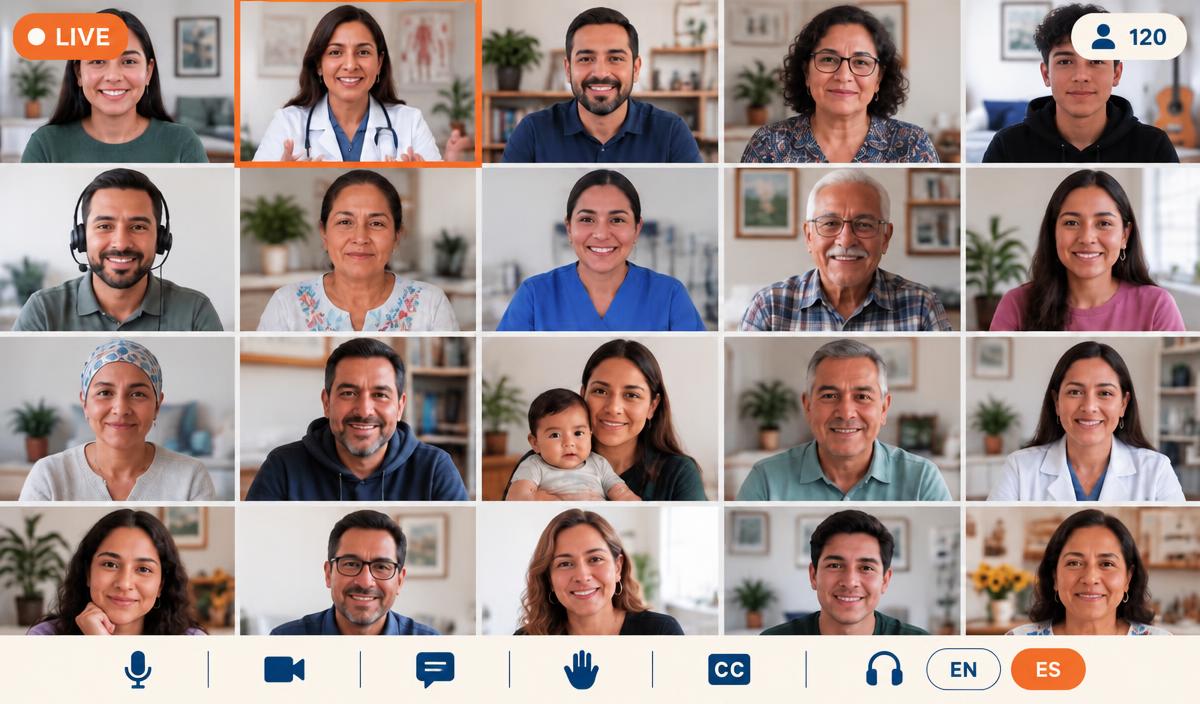
Your webinar on diabetes prevention is ready. The speakers are confirmed, the slides are polished, and your registration list includes hundreds of Spanish-speaking patients, community health workers and clinicians. Then someone asks the question that gets skipped more often than it should: how will they actually follow along?
This guide is for the people who organize healthcare webinars, trainings and online conferences in the United States. It explains how remote simultaneous interpretation (RSI) works, what separates a smooth interpreted event from a frustrating one, and the details most guides leave out.
Why Spanish-speaking audiences deserve more than a translated slide deck
Spanish is by far the most common language among U.S. residents with limited English proficiency (LEP): roughly 16 million people as of 2019, according to figures compiled from Census data. A translated PDF helps, but it does not let someone follow a live presentation, ask a question or take part in a discussion.
It also helps to remember that “Spanish-speaking” is not one audience. People of Mexican origin make up the majority of the U.S. Hispanic population (about 57% in 2024, per Pew Research Center). Yet in the New York metro area, Dominicans and Puerto Ricans are the largest groups, and in the Washington, D.C. area roughly a third of Latinos are of Salvadoran origin. Vocabulary, accents and expectations differ, and your interpreters should be chosen with that in mind.
What simultaneous interpretation means in a webinar
In simultaneous interpretation, interpreters listen to the speaker and render the message into another language with only a few seconds of delay. Attendees choose a language channel and hear the interpreter instead of, or alongside, the original audio.
Two setups are common:
- • Language channels inside your video platform. Zoom, for example, lets hosts assign interpreters to channels, and Spanish and Portuguese are among its default languages. Attendees open the interpretation menu, pick a language and can mute the original audio. A few practical limits matter: the feature requires a paid plan, it cannot be used with a Personal Meeting ID, and participants and interpreters must join with computer audio.
- • A dedicated RSI platform. These add features such as smoother handovers between interpreters, private channels for the interpreting team and attendee apps. They are worth considering for larger or higher-stakes events.
En cualquier caso, la plataforma solo entrega el audio. La calidad de la experiencia depende de los intérpretes y de qué tan bien preparados estén.
Why a bilingual colleague is not enough
Being fluent in two languages is not the same as being able to interpret. Simultaneous interpreting is among the most mentally demanding tasks in professional communication, which is why the standard is a team of two interpreters per language who take turns.
Automated translation tools raise a similar concern when they are used on their own. Healthcare content has little tolerance for error: a wrong number in a dosage instruction or a misrendered warning is not a small mistake. For the main audio channel, human interpreters are the safer choice, and whatever you decide, test it with your own content before the event.
There is also a compliance angle for many healthcare organizers. Under the 2024 final rule implementing Section 1557 of the Affordable Care Act, covered health programs must use qualified interpreters when offering language assistance to people with limited English proficiency, and HHS guidance is explicit that someone simply saying they speak the language does not make them qualified. Covered entities are also expected to have documented language access procedures.
Whether a specific webinar falls under these rules depends on the organization and the type of event, and enforcement priorities can change. Confirm with your compliance team or counsel. Even where the rule does not apply, it is a useful benchmark for what “qualified” should mean.
The details that make or break an interpreted health webinar
Most articles stop at “hire a professional.” These are the points that decide whether the event actually works.
1. Decide how Spanish speakers will ask questions
This is the most common gap. If Spanish-speaking attendees can only listen, you have given them access to the content but not to the conversation. Plan the Q&A in advance: interpreters can voice spoken questions into English, or a moderator can read Spanish chat questions aloud. Tell attendees at the start exactly how to participate.
2. Send materials early, with a glossary
Interpreters cannot prepare for what they have not seen. Send the agenda, slides, speaker bios and any scripts well before the event, ideally at least a week ahead, and flag the terms that matter: drug names, procedures, acronyms and the names of programs or clinics. A shared glossary agreed with your interpreters prevents the same concept from being rendered three different ways. It also pays off across a series, because each event builds on the last.
3. Choose the Spanish your audience actually speaks
Patient education and clinical training call for different registers. A talk for patients needs plain language and a respectful, consistent form of address. A session for clinicians may keep technical terms and borrow English ones. Regional vocabulary also varies: the same condition or medication can be called different things depending on where your audience comes from. Tell your interpreters who is listening and where they are from.
4. Design the presentation for interpretation
Speakers who race through dense slides force interpreters to compress or drop information. A few simple habits help: speak at a measured pace, avoid reading slides aloud at speed, spell out acronyms the first time, and be careful with idioms and humor that do not travel. Brief your speakers before the event. This is the cheapest quality improvement available.
5. Protect privacy
If the session includes patient stories or case discussions, remove identifying details. If protected health information could be shared, talk to your compliance team about whether the interpreters should sign confidentiality or business associate agreements, and decide in advance whether the recording will include the interpreted audio.
6. Rehearse the technology with the interpreters
Run a short technical check before the event with the host, the main speakers and the interpreters. Confirm that channels are assigned, audio is clear and the interpreters have a backup way to reach the producer if something fails. Most day-of problems come from skipped rehearsals.
7. Plan the recording
A recording with only the English audio defeats the purpose for Spanish-speaking audiences who watch later. Decide whether you will record the interpreted channel or publish a separate Spanish version.
A note on Portuguese-speaking audiences
If your audience includes Portuguese speakers, plan for it separately. Portuguese ranks third among LEP languages in the Northeast, with several hundred thousand speakers in that region. In Massachusetts it is the second most common LEP language after Spanish. Brazilian immigrants are concentrated in Florida, Massachusetts and California, with New Jersey and New York close behind, and the largest communities are around Boston, New York and Miami.
Two practical points. First, specify Brazilian or European Portuguese, because audiences differ. Second, check actual demand: Brazilian immigrants are, on average, less likely to have limited English proficiency than the overall foreign-born population. A language question on your registration form will tell you whether a Portuguese channel is worth adding.
Beyond the clinic: sports medicine and clean-sport education
One place where interpreted webinars are already routine is anti-doping education. Organizations such as the International Testing Agency, WADA and international sports federations run recurring English-language webinars with simultaneous interpretation into Spanish and other languages. Topics include checking medications, therapeutic use exemptions and the risks of supplements. That is clinical vocabulary where a misunderstanding has real consequences for an athlete.
These examples come mostly from international bodies rather than U.S. organizations, but the lessons carry over to team physicians, pharmacists, athletic trainers and university athletic departments serving Spanish-speaking athletes and support staff. Recurring series reward consistency: when the same interpreters work every session, the glossary improves and so does the quality.
A simple planning timeline
| When | What to do |
|---|---|
| 4 weeks before | Define audiences and languages, choose the platform, book an interpreting agency (or independent interpreters) |
| 2 weeks before | Brief the interpreters, share the draft agenda and start the glossary |
| 1 week before | Send final slides and scripts, confirm the Q&A plan, brief the speakers |
| 1 to 2 days before | Technical rehearsal with the host, speakers and interpreters |
| Event day | Open the room early and test every channel so that all audio, original and interpreted, is heard clearly; announce how to select a language channel |
| After the event | Share the recording with interpreted audio and update the glossary |
Questions to ask any interpreting provider
- Do you provide two interpreters per language for events longer than about an hour?
- Do your interpreters have experience in this health topic?
- How do you handle questions from Spanish-speaking attendees?
- How do you protect confidential information?
- What is included in your quote: preparation time, rehearsal, recording and backup interpreters?
How does ¡Habla! Translation & Interpretation help?
¡Habla! Traducción & Interpretación ofrece interpretación simultánea remota para webinars, capacitaciones y conferencias en línea desde Latinoamérica. Trabajamos inglés<>español, también ofrecemos portugués<>inglés, francés<>inglés, ruso<>inglés, chino mandarín<>inglés, entre otros idiomas. Compartimos la hora estándar de EE. UU.
If you are planning a healthcare webinar or training for Spanish-speaking audiences, we are glad to talk through your event and share what we have learned along the way.

